

How Do Officers Really Feel About I Got Your Six Tattoo
In that location'due south an action pic cliché in which a cop inspects the body of a felled assassin or pes soldier and discovers a curious tattoo that ultimately leads to a rogue black-ops squadron, a hole-and-corner religious sect, or an hole-and-corner drug trafficking ring.
The trope isn't entirely Hollywood fantasy, just the reality of emerging tattoo recognition engineering science is closer to a dystopian tech thriller. Soon, we may meet police departments using algorithms to scrape tattoos from surveillance video or cops in the field using mobile apps to analyze tattoos during stops. Depending on the tattoo, such applied science could be used to instantly reveal personal data, such as your religious behavior or political affiliations.
For years, police force enforcement has used tattoos to identify criminal suspects every bit well as unidentified victims. Police force have also used tattoos to map out subcultures and networks of gangs and hate groups. Until recently, nonetheless, tattoo matching and analysis has involved flipping through the pages of photograph binders; any calculator-assisted matching has been limited to metadata searches of keywords.

NIST'due south Official Tattoo Recognition Technology Logo
In 2014 and 2015, federal researchers at the National Institute of Standards and Technology (NIST) joined forces with the FBI to launch a plan to accelerate tattoo recognition engineering. As part of Tatt-C (the code name for NIST'southward "Tattoo Recognition Engineering science Challenge"), officials assembled a behemothic dataset of prisoner tattoos and divvied it out to biometric companies, research institutions, and universities. They were asked to run five experiments to show how well their algorithms could match tattoos under various circumstances.
Some tests involved matching different photos of the same person's tattoo. Other experiments sought to friction match similar tattoos on dissimilar people based on their characteristics—such every bit a crucifix, Minnie Mouse, and Chinese calligraphy. These tests pose serious concerns for privacy, free expression, religious freedom, and the right of association.
Each one of these experiments correlated to a specific law enforcement use. The Tatt-C results, released concluding summertime, now serve as a crystal ball into what law enforcement has planned for this engineering over the years to come up.
Hither are the five tests and what they tell use about the future of tattoo recognition technology.
Related: Acquire why EFF is calling for an finish to this research.
Note on the information: The Tatt-C dataset contained xv,000 images obtained past the FBI from prisoners. The dataset was split up into subsets and sub-subsets for individual trials. Tatt-C participants self-reported their results, which were not independently verified. The percentages beneath reverberate the accuracy within the experiment, and not necessarily how accurate the engineering would perform in the real world.
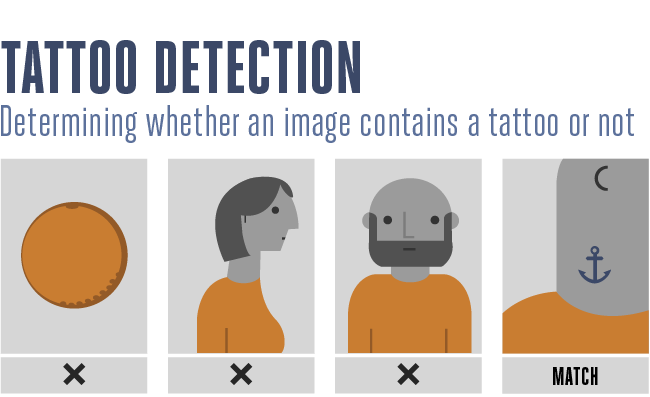
Tattoo Detection:Why would police want algorithms that can detect whether an paradigm has a tattoo or non?
Whatsoever given law enforcement bureau may be sitting on an immense, unsorted collection of images. Mugshots, scars, birthmarks, and tattoos—all mixed upward together, some unlabeled, some mislabeled. Without computer assistance, information technology could accept significant staff-power to sort through information technology all. NIST suggests that automated tattoo detection would streamline an agency's ability to classify images.
Perhaps the more concerning use case for privacy advocates is that tattoo detection technology would too pave the way for algorithms to isolate tattoos from images scraped from the Net or captured by security cameras.
The bad news is the technology is already highly sophisticated.
Tatt-C'due south inquiry team reported back that three different organizations' algorithms could observe a tattoo in an image with more than xc% accuracy. The private biometric technology company MorphoTrak (a subsidiary of Safran) claimed the best effect; their algorithm was able to detect whether an paradigm independent a tattoo or not with 96.3% accuracy.
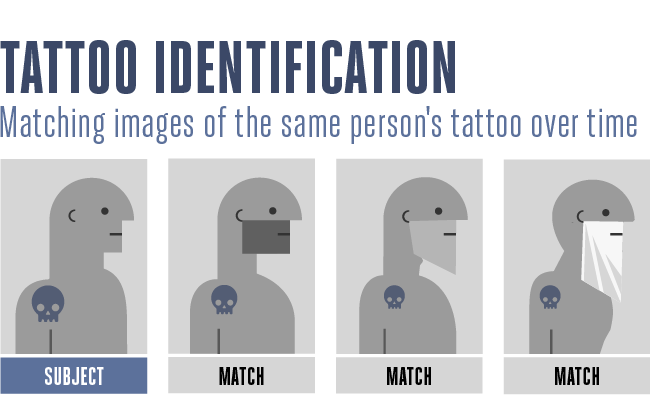
Tattoo Identification:When we say biometrics, we are talking about unique physical or behavioral characteristics that can be used to identity you. Fingerprinting has been used by criminal justice agencies for over a century to place suspects; tattoo recognition can be used in much the same fashion.
Let'due south say a cop is questioning someone on the street who refuses to provide an ID card. The officeholder could run a photograph of one of the person's tattoos through a database to notice a photo of the aforementioned tattoo captured during a previous arrest. Ane situation NIST imagines is applying tattoo recognition engineering to video surveillance of a robbery in which the suspect is wearing a mask but a neck tattoo is visible.
But as facial recognition technology raises serious privacy concerns, people should be wary of tattoo recognition engineering'southward invasiveness. Not only tin can it identify everyday people defenseless on photographic camera while going almost their business, it could eventually lead to tracking people using their tattoos.
NIST asked Tatt-C participants to match a photo of a tattoo to other pictures of the photograph taken over fourth dimension. Four different companies and research institutions reported that their algorithm could return a hit on the first outcome with more than 95% accurateness. Again, MorphoTrak came out on tiptop, returning a hitting with 99.4% accuracy.
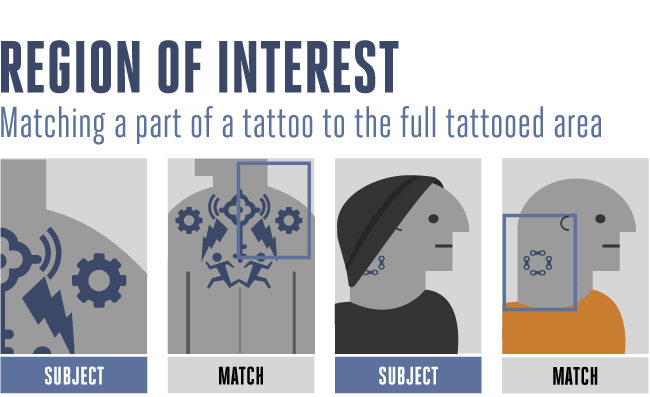
Region of Involvement:NIST uses "Region of Interest" to describe how well an algorithm can match a small piece of a tattoo to a wider epitome of the whole tattoo. For instance, could the algorithm recognize that a tiny skull tattoo is part of a larger half-sleeve arm tattoo.
The idea here is that sometimes merely a portion of a tattoo is caught on surveillance; is that enough to identify someone if constabulary accept the whole tattoo on file? This technology would also help constabulary match a tattoo, even if the person subsequently added more to the design.
Yet once more, MorphoTrak provided the nearly authentic results: the algorithm could render a hit on the first consequence with 94.6% accurateness. Purdue University, which has developed an app [.pdf] with support from the U.South. Department of Homeland Security, was shut behind with 91.6% accuracy.
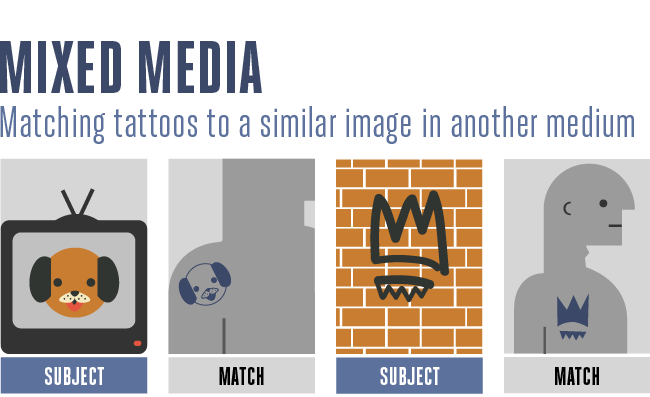
Mixed Media:When you go a tattoo, the artist rarely inks their first draft on your skin. The creative person will describe it out on paper, and so turn it into a royal transfer to trace out with the needles. The question for researchers is whether an algorithm can reverse engineer this procedure; rather than matching tattoos to tattoos, can they match a tattoo to an image in another medium.
If a witness sees a tattoo during a crime, they could describe it for a sketch artist, who could run the sketch through a tattoo database. Or, if an officer wants to run into if a tattoo correlates to a gang symbol, the tattoo could exist compared to street graffiti.
But this technology sets law enforcement on a unsafe path, since it would allow a law officer to acquire more than than just your identity, simply your interests, political behavior, or organized religion. An investigator could plug an prototype of an Agitator circle-A or the Republican elephant into its database to render a list of people who have tattoos of those images.
This technology is on the horizon, but at this phase it is yet relatively underdeveloped.
The MITRE Corporation—a non-profit arrangement that manages research centers on behalf of the federal government—produced the most successful results. The algorithm could produce matches within the first 10 results with 36.5% accuracy.
Although that number is fairly low, that may non prevent law enforcement from using it to generate leads. However, less reliable algorithms have greater potential of capturing innocent people in investigations.
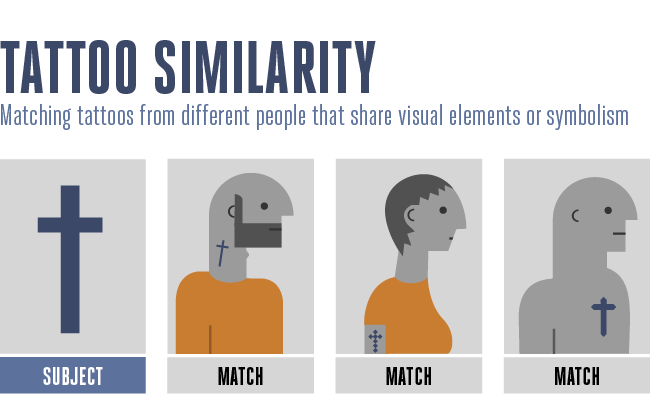
Tattoo Similarity:1 of the virtually worrisome applications of tattoo recognition engineering is its potential ability to reveal connections or shared beliefs amid a population. For example, rather than matching a particular tattoo of a crucifix with an individual, police could run the paradigm of a crucifix through a database to produce a long set up of people with similar cross tattoos. This essentially means constabulary would be able to create lists of people based on their religion, politics, or other affiliations as expressed by their tattoos.
This type of tattoo matching could sweep up fans of the same bands or members of the same labor matrimony or military unit of measurement. This awarding has a high likelihood of generating false positives—matching someone whose tattoo may be visually like, but not really symbolically similar. That could result in people existence improperly associated with groups, such equally gangs, with which they accept no bodily affiliation.
Law enforcement primarily wants to utilise this technology to identify members of gangs and hate groups, who often employ coded symbols to express their affiliation. Just that's not necessarily what NIST researchers focused on during Tatt-C's "Tattoo Similarity Experiments," which tested how well algorithms could match different tattoos with like visual features. Many of the images NIST asked participants to clarify were religious symbols—often Cosmic iconography, such as easily property rosaries and Jesus Christ's crucifixion.
This should heighten bright red flags for those concerned virtually religious freedom, especially in light of how authoritarian governments accept used tattoos to oppress religious minorities. Nazi Federal republic of germany's use of tattoos to rail Jews during the Holocaust comes to mind. Indeed, the 6-pointed Star of David was one of the images used during the NIST experiments. However, in that instance, the star also serves as the symbol of the Gangster Disciples, a Chicago street gang. So even when law enforcement is attempting to utilize tattoos to investigate gangs, people who are just expressing their religion could be labeled as affiliates of criminal gangs.
The skillful news is that the technology is still in its early stages. Researchers attributed the drib in accuracy to a problem they chosen the "semantic gap." That refers to the difficulty computers have in divining significant from tattoos that contain relevant symbols, only are not clearly visually similar. MITRE achieved the best results; its algorithm could establish a correct match within the start 10 results with 14.ix% accuracy.
What'southward Next
Although the NIST and FBI experiments were largely bookish inquiry exercises, law enforcement is already deploying the technology. Purdue Academy, with support from the Department of Homeland Security, has adult a graffiti and tattoo matching app—GARI—that is at present in use by law enforcement agencies across the land of Indiana. Meanwhile, companies like MorphoTrak and DataWorks are now offering tattoo recognition as part of biometric software packages that also include fingerprint scanning, iris scanning, Deoxyribonucleic acid analysis and facial recognition. Nosotros know that sheriff's departments in California have contracts with these companies.
It'due south also clear that the lessons learned from the Tatt-C projection are being used to refine future inquiry and tattoo recognition engineering. Following the Tatt-C project, NIST released training materials for law enforcement that explained how camera framing and lighting can make tattoos more hands recognizable by algorithms. Researchers further recommended that an even larger dataset—more than 100,000 images—be compiled for distribution to third-political party researchers.
This summer, NIST plans to launch its adjacent major series of experiments: Tatt-E, short for the Tattoo Recognition Technology Evaluation. Using tattoo databases from the Michigan State Police force, Tennessee Section of Corrections, and the Pinellas County Sheriff's Office in Florida, NIST intends to run a like set of tests internally, connecting to each algorithm through an API.
 For the sake of civil liberties, privacy, and nobility, we believe that NIST should halt this program immediately. Take action now to call for an finish to experimentation with our tattoos.
Source: https://www.eff.org/deeplinks/2016/05/5-ways-law-enforcement-will-use-tattoo-recognition-technology
Posted by: reynoldsglearand.blogspot.com
0 Response to "How Do Officers Really Feel About I Got Your Six Tattoo"
Post a Comment